The Problem with Traditional B2B Lifecycle Models (And What to Do Instead)

Rachit Puri

Delivery Partner
Your field marketing team compiled a warm list of attendees and marked them as an MQL for the sales team. Your sales team followed up, and even had a few email exchanges, and generated an Opportunity. But suddenly, the prospect team went silent. The Opportunity is marked as “Closed-Lost.”
Six months later, that same prospect resurfaces at another event, showing signs of engagement and intent. The prospect could qualify as a repeat MQL, but in your lifecycle model, they are still marked as “Closed-Lost” and can not re-enter the funnel.
Sound familiar?
This is a very common and fundamental flaw of traditional lifecycle models. They assume buying journeys are linear. However, in reality, buyers move backward, forward, and jump across different lifecycle stages before making a decision.
If your lifecycle model can’t track these non-linear buyer journeys, you’re reporting incorrect funnel data, misattributing pipeline impact, and frustrating both your marketing and sales teams.
In this article, we’ll break down:
- Why do traditional lifecycle models fail?
- How to build a lifecycle model that actually works.
- Business benefits of an advanced lifecycle model.
Why Traditional Lifecycle Models Are Failing
The linear lead lifecycle model was created when B2B buying was simpler. Fewer stakeholders were involved, buying cycles were shorter, and sales reps controlled more of the information flow.
There are several reasons the traditional lifecycle model no longer suits the current buying landscape:
1. Non-linear buying journey
Everyone is familiar with the classic B2B lifecycle model:
Known → Engaged → MQL → SAL → SQL → Opportunity → Closed-Won
On paper, it looks clean. It provides clear handoff points, structured reporting, and an easy way to measure funnel performance. But real buyers don’t behave this way.
Today’s B2B buying process is anything but linear. About 86% of B2B purchases stall during the buying process. There are several reasons for this. For instance, a potential customer might download a whitepaper, have initial sales conversations, and then disappear for months. Or a key decision maker might leave. Yet, most companies still try to fit buyers into a rigid, one-directional funnel, and that creates major issues.
2. MQL and SQL Confusion
Most lifecycle models classify leads as MQLs and SQLs. While this is a structured approach to lead progression, it also introduces misjudgments in lead readiness. Many leads are marked as “qualified” just because they downloaded a whitepaper or attended a webinar, even if they’re not ready to buy. Meanwhile, high-value prospects might get ignored simply because they don’t meet arbitrary scoring criteria. If a lead is marked as Closed-Lost, most systems don’t track when they re-enter the buying process—causing sales teams to miss key re-engagement opportunities.
3. Ignoring Multiple Entry and Exit Points
Traditional lifecycle models assume that every lead follows the same path. It starts as an inbound lead, moves through marketing nurture, and then is handed off to sales. But real buyer journeys don’t work like that. Some leads start by downloading content, others by engaging with ads or attending webinars, and some are brought in through outbound sales.
A traditional linear model only tracks a single starting point. If a lead enters through outbound sales rather than marketing, it won’t be properly tracked within marketing funnel reports. Similarly, if a deal is lost but later re-engages, there’s no structured way to track its reactivation.
4. Poor cross-departmental collaboration
The traditional lifecycle model treats marketing, sales, and customer success as separate entities, each responsible for a specific stage of the funnel. This rigid structure creates misalignment between teams and silos where each team only tracks their part of the process.
In reality, customers don’t engage in neat, department-specific stages. Their journey is continuous and interconnected. Without sales and marketing alignment, companies lose visibility into key touchpoints that influence revenue, such as post-sale engagement, re-engagement opportunities, or expansion potential.
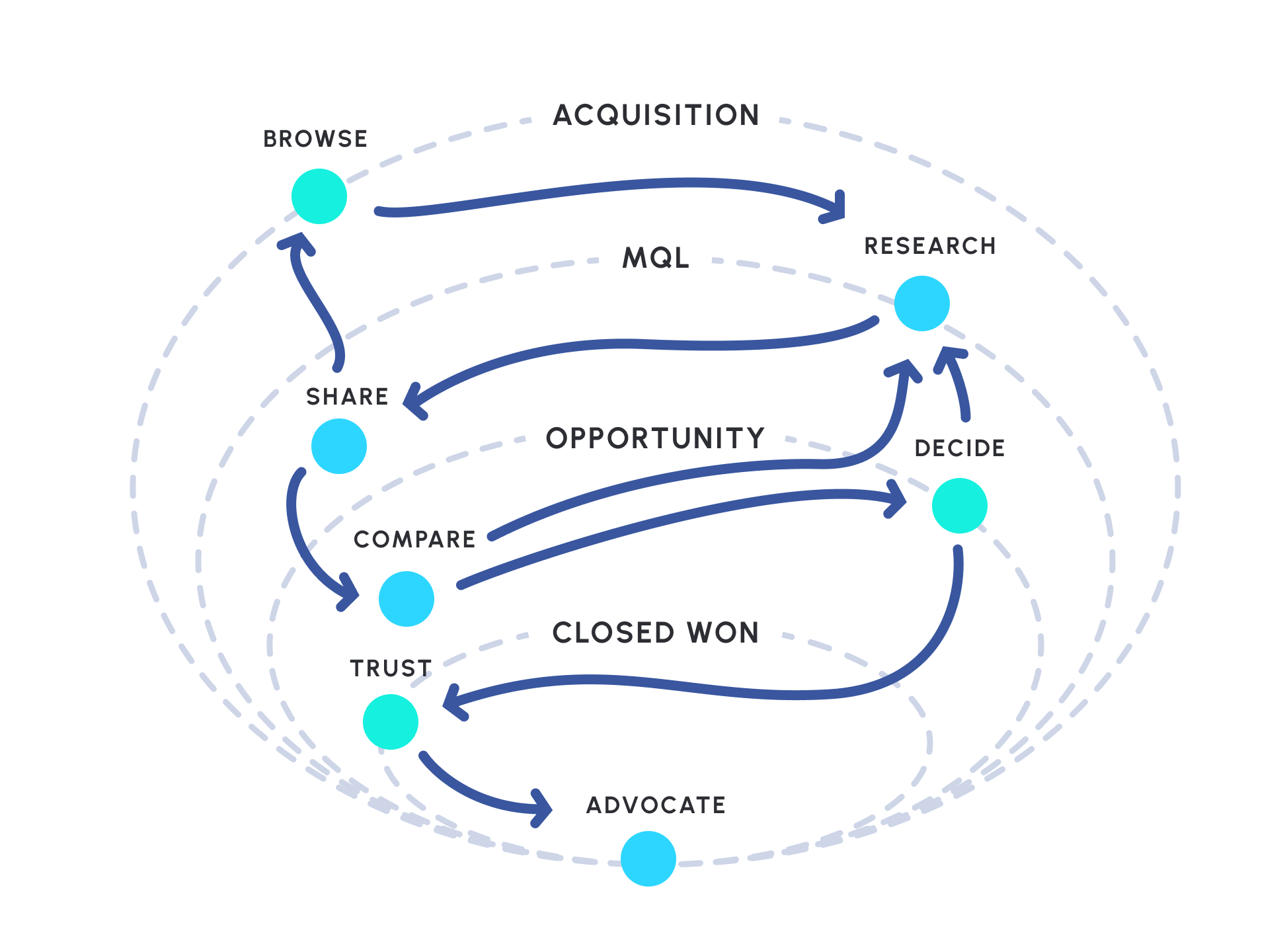
What today’s RevOps teams need is an advanced, multi-path lifecycle model that is flexible, intent-driven, and reflects the real complexity of B2B buyer journeys. Unlike traditional linear models that force leads into predefined sequences, a mature model adapts dynamically based on engagement, behavior, and intent signals across marketing, sales, and customer success. Here’s how it looks in real life:
What should you consider when implementing a lifecycle model?
Here are some tips for building a mature lifecycle model:
- Recognize Multiple Lifecycle Journeys
Implement a lifecycle framework that accommodates multiple conversion routes, recognizing that prospects don’t always follow a straight line, and can become a Sales Ready more than just once. - Embrace Outbound Outreach as part of the funnel
Implement specific stages to handle all records that are brought in from third-party data sources like Apollo.io, Zoominfo, and SDR teams work on warming them for your Sales team. - Track Engagement Across the Entire Revenue Team
Create a unified tracking system where all touchpoints (marketing nurture, sales interactions, and customer success engagements) and channels (paid, social, organic, syndication, outbound) contribute to a holistic view of the buyer’s lifecycle journey. - Allow Non-Linear Movement
Keeping prospects in a one-way linear path creates a rigid system for your marketing and sales team. Design a model where your lifecycle stage tracking fields, scoring model, engagement programs, paid marketing audiences, and ABM programs adjust dynamically based on buyer behavior. - Consider Opportunity at an MQL Stage Model
Creating the Opportunity at the MQL stage aligns the BDR/Sales team to have one single object and a unified view of the entire sales funnel.
Another primary benefit of the creation of an Opportunity at the MQL Stage is that this allows you to report on multiple journeys throughout the funnel, as not all records will progress linearly.
Similarly, the compositional attributes of the company may change in repeat journeys, and being able to capture and store that data will help you understand how different types of accounts progress through the funnel as well as what influences their progression.
What should you consider when implementing a lifecycle model?
You need an advanced lifecycle model if you face challenges in tracking, managing, and optimizing the movement of prospects through your funnel. The below questionnaire will help you determine if you’re good with a linear lifecycle model or if you need to advance.
| Question | Yes | No |
| Are you crediting a single source for lead generation? | Your attribution model may be oversimplified. Consider multi-touch attribution to better understand the full buyer journey. | You should ensure that for each stage proper source and channel is tracked. This helps identify which source / channel works better for which lifecycle stage. |
| In your CRM, are there deals that had multiple marketing and sales interactions? | This indicates that a linear model may not capture the true journey. Implement tracking for multi-touch engagement. | You may need to investigate if tracking is missing multi-touch interactions or if engagement is truly limited to one source. |
| Do your prospects interact with multiple departments (Marketing, Sales, CS) before making a decision? | A cross-functional lifecycle model can help track and align interactions across teams. | Either your sales process is highly direct, or your tracking is incomplete. Review how buyers interact before purchase. |
| In your current model, do your prospects move backward in lifecycle stages? | This is a sign that a rigid lifecycle model isn’t capturing real buyer movement. Consider allowing non-linear transitions. | If this is accurate, your lifecycle model is working well, but ensure you are not losing potential re-engagements. Ensure that the tracking data for each stage is updated accordingly. |
| Do your prospects skip lifecycle stages (e.g., MQL to Closed-Won)? | Skipping stages suggests a need for a more flexible lifecycle model based on intent rather than predefined steps. | Your current model is structured well, but make sure it’s allowing flexibility when needed. |
| Do you have leads marked as Closed-Lost that later re-engage and convert? | You should track re-engagement separately and nurture these leads differently rather than treating them as new. | Check if your team is missing opportunities for re-engagement and if ‘Closed-Lost’ is truly final. |
| Are there significant delays between marketing handoff and sales action? | This suggests misalignment between teams. Introduce real-time engagement tracking to improve handoffs. | Your handoff process is well-optimized, but continuous monitoring can ensure efficiency. |
| Do your lifecycle stage conversion rates show a healthy and explainable pattern across each stage? | Good! This suggests a well-aligned lifecycle, but check if stagnation occurs over time. | Inconsistent conversion rates may indicate that your lifecycle model isn’t properly identifying sales-ready leads. |
| Do you track how often leads re-engage after being marked inactive? | Leverage this data to create a dedicated re-engagement strategy rather than starting fresh. | You may be missing valuable opportunities. Consider tracking returning leads and analyzing their intent. |
| Are customer expansion and upsell opportunities part of your lifecycle tracking? | Great! Post-sale engagement should be an integral part of the lifecycle model. | You might be overlooking revenue opportunities. Include customer success touchpoints in your lifecycle tracking. |
How Can RevOps Global Help?
A linear lifecycle model isn’t bad. In fact, it’s a great starting point for companies that want to establish structure and alignment. The problem arises when businesses stop there.
At RevOps Global, we specialize in Advanced Lifecycle Modeling in Salesforce, helping companies overcome complex lifecycle challenges. Our custom solutions provide full GTM funnel visibility, with multi-entry tracking, reliable data retention, flexible scalability, and seamless reporting—all within Salesforce. A key differentiator of our approach is cohort-based lifecycle analysis, enabling teams to track and compare how specific groups of leads or accounts progress through the funnel over time. This gives revenue teams a deeper layer of insight to optimize conversion strategies and forecast more accurately.
Book a demo today to see how a dynamic, multi-path lifecycle model can transform your pipeline.